
Mini soccer rules: what is different about Under 7 to Under 11 football
Watching your child's first season of mini soccer, half the things that happen on the pitch are not in the game you grew up with. Nobody throws the ball in. The other team walks back to their own half for a restart. At Under 7 there is no goalkeeper and no referee at all.
None of it is a local invention. The FA's Mini-Soccer Handbook (opens in a new tab), updated in August 2026, sets the U8 to U11 Mini-Soccer laws and points U7 readers to the separate FutureFit 3v3 guidance. This season has changed more of the pathway than usual.
Mini soccer formats and laws are set by The FA and change between seasons. This page uses the August 2026 Mini-Soccer Handbook, current FutureFit 3v3 guidance and the 2026/27 Standard Code. Some figures are maximums and others are recommendations, as labelled.
Information checked on
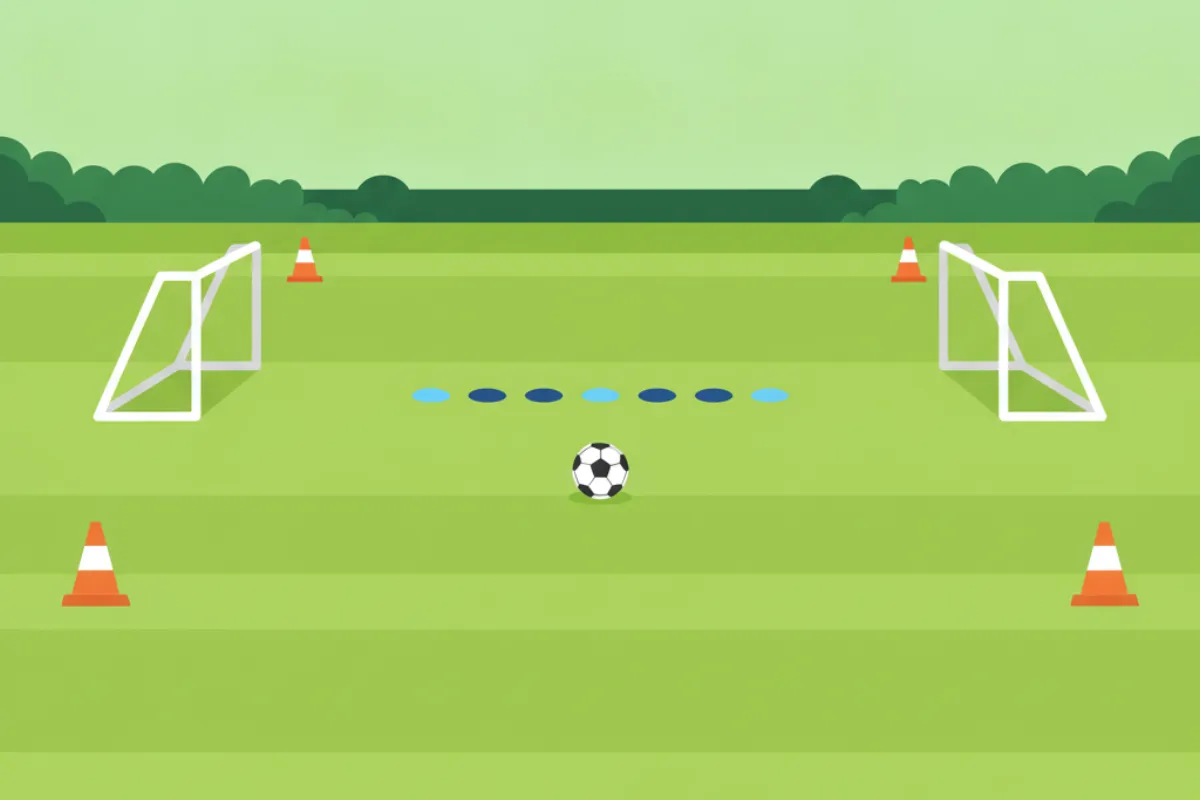
The short version
- Under 7 is 3v3 this season, and it runs under its own rules rather than the mini soccer laws. Under 8 and Under 9 are 5v5, Under 10 and Under 11 are 7v7. Those are the maximum permitted formats.
- Everyone plays with a size 3 ball.
- There is no offside at Under 7 to Under 11, and no throw-ins. A pass-in or dribble-in replaces them.
- The grassroots rule removes deliberate heading at Under 7 to Under 11. Our heading guide covers the full scope and exception.
- At Under 8 to Under 11, the team without the ball retreats to their own half at goal kicks. At Under 7 the same idea applies at goal line restarts.
- These age groups play development football rather than a league season with a table.
- Playing time is capped. At Under 7, FutureFit recommends 30 to 40 minutes across the matchday and the daily maximum is 60 minutes. From Under 8, the handbook recommends at least 50 per cent of each game for every player where possible.
What changed for 2026/27
- Under 7 is now 3v3, with its own set of rules. It is the entry format, designed for more touches, more decisions and more involvement.
- Throw-ins are gone from Under 7 to Under 11. A pass-in or dribble-in replaces them.
- The grassroots deliberate-heading phase-out now covers Under 7 to Under 11. Under 11 was the final age group added in 2026/27. Our guide to heading in youth football covers the rule, restart and scope in full.
The wider set of changes sits on The FA's FutureFit hub (opens in a new tab), which is where the format guidance for every age group now lives.
Under 7: 3v3 is a different game
The FA's 3v3 guidance (opens in a new tab) does not describe a smaller version of mini soccer. It describes a different format, and most of what follows in this guide does not apply to it.
- No goalkeepers. All six players are outfield players.
- No officials. One adult facilitator per pitch, helping the children make their own decisions.
- No substitutes. Every child plays.
- Size 3 ball, with recommended goals of 120 by 75 centimetres, about 4ft by 2.5ft.
- Each 3v3 match lasts 6 to 10 minutes. FutureFit suggests moving players around several pitches in a simple carousel, creating a recommended 30 to 40 minutes of playing time each. Up to four 3v3 pitches can fit on the space used for one 5v5 pitch.
- No heading and no penalty kicks. Any free kick must be at least 3 metres from the goal, and opponents stand at least 3 metres away at every restart.
- Players can dribble or pass at every restart: goal line, corners, sidelines and free kicks.
- At goal line restarts, the opposition retreat to their own half.
- A player has to be in the opponents' half for a goal to count.
- After a goal, the conceding team restarts from their goal line and the scoring team returns to theirs.
- FutureFit's matchday model starts games with a high five and uses rock, paper, scissors as a simple way to decide who starts.
The format is deliberately flexible. Pitches can be marked with cones and varied between 10 by 15 metres and 15 by 20 metres. Coaches can agree smaller-sided games such as 2v2 or 3v2 when numbers are short, and can mix squads where that works for the players. The Under 7 game is non-competitive.
The formats, age by age
- Under 8 and Under 9. 5v5, matchday squad of 10 or fewer, maximum 40 minutes per game in two halves of 20, maximum 60 minutes in a day.
- Under 10 and Under 11. 7v7, matchday squad of 14 or fewer, maximum 50 minutes per game in two halves of 25, maximum 90 minutes in a day.
Those U8 to U11 figures are maximums from the handbook. Each league sets its own playing time up to the limit, and games can be split into quarters within it. At Under 7, the Standard Code gives a daily maximum of 60 minutes, while FutureFit recommends individual 3v3 games of 6 to 10 minutes.
The daily maximum belongs to the child, not the team. FA guidance puts responsibility for staying within it on the club and/or the parent or carer, which matters at festivals where a child could otherwise play across several games.
The rules that look strange from the touchline, at Under 8 to Under 11
- The retreat line. At a goal kick, the team without the ball retreats to their own half until the ball is in play. The goal kick can be taken from anywhere in the penalty area, by any player. Once the ball is kicked and clearly moves, the other team can press.
- No offside. Players can be anywhere on the pitch at any time, except where the retreat line applies.
- Goals are 12ft by 6ft, rather than the smaller goals used at Under 7.
- Pass-in or dribble-in. Ball stationary on the touchline where it went out, only the kicker off the pitch, opponents five yards back, no goal direct from it, and the kicker may play it again.
- All free kicks are direct, except the indirect free kick for a deliberate header.
- The back pass rule applies from Under 8. Not at Under 7. Where it applies, a goalkeeper cannot pick up a ball deliberately kicked to them by a teammate, and the free kick is taken on the penalty area line nearest the incident.
- Five yards is the standard distance, at free kicks, corners, pass-ins, dropped balls and kick-offs. At Under 7 the equivalent distance is 3 metres.
- Rolling substitutions. Roll-on, roll-off at any time with the referee's permission, including players who have already been substituted.
Power play
Power play is an option leagues can adopt at 5v5 and 7v7. It is not used at Under 7.
- A team losing by four goals can add one extra player.
- If the gap comes back below four, they take a player off, and it does not have to be the one who came on.
- At a six goal difference, another extra player can be added.
The aim is that everybody stays challenged and involved rather than a game becoming a procession.
No leagues, and three trophy events
The handbook says children from Under 7 to Under 11 do not play in leagues. That surprises parents whose child clearly plays in something called a league, so it is worth unpacking. Competitions still organise fixtures and divisions at these ages. What they do not run is a season-long published league-table competition.
From Under 8, a team can play in up to three trophy events a season: three over two-week periods at Under 8 and Under 9, and three over four-week periods at Under 10 and Under 11. Trophies can be awarded and those results published. Outside them, the Standard Code (opens in a new tab) allows a competition to collect results and grading tables but not to publish them at these ages.
That is why there is no table to check on a Sunday night, and it is deliberate. Our guide to how youth leagues work covers what changes from Under 12.
Kit and equipment
- Shin pads are compulsory, and must be covered entirely by knee-length socks.
- Footwear has to suit the surface.
- From Under 8, goalkeepers wear a different colour from the rest of the team. There are no goalkeepers at Under 7.
- In poor weather, players should wear appropriate clothing, but hoodies are not allowed.
- Where a player wears clothing as a requirement of their faith, the handbook expects the referee to accommodate it. Wearing shorts over trousers is not required and should not stop anybody playing.
Who referees, and what they are doing
At Under 8 to Under 11, anybody refereeing a Mini-Soccer match has the authority to apply its laws, whether or not they are a qualified referee, and assistant referees are not required. The handbook asks referees to explain their decisions and help the children learn the game, which is worth remembering before shouting at one. At Under 7 there is no referee, just one adult facilitator per pitch.
Behaviour has its own framework. The Grassroots Code (opens in a new tab) sets the standards, and Silent Support weekends (opens in a new tab) run nationally on 14 and 15 November 2026 and 13 and 14 March 2027, with leagues able to hold their own as well.
Elsewhere in the UK
These are the laws for mini soccer in England. Scotland, Wales and Northern Ireland set their own youth formats and rules through their own associations.
Common questions
What is different about Under 7 this season?
Almost everything. Under 7 is now 3v3, with no goalkeepers, no substitutes and no referee, just an adult facilitator on each pitch. Games last 6 to 10 minutes, and FutureFit suggests a carousel of short games to give each child around 30 to 40 minutes of football.
How long can my child play in one day?
Sixty minutes at Under 7, Under 8 and Under 9, and 90 minutes at Under 10 and Under 11. FA guidance says the club and/or the parent or carer are responsible for making sure the child's daily maximum is not exceeded.
Does every child have to get equal playing time?
The handbook says all team members should receive equal playing time where possible, with a best practice recommendation of at least 50 per cent per player per game, and that applies from Under 8. At Under 7 there are no substitutes at all, so every child plays the whole of each short game.
Why is there no league table?
Because these ages play development football rather than a season-long published league-table competition. Fixtures and divisions still exist, but results and grading tables cannot be published, except for the permitted trophy events from Under 8.
Why did the other team put an extra player on?
Power play, if the league has adopted it, at 5v5 or 7v7. A team four goals down can add a player, and takes them off if the gap closes. It does not apply at Under 7.
Can my child play up an age group?
Generally, yes. The 2026/27 Standard Code permits a child to play one age group above their chronological age group, even where the format changes. One important exception is a child who turns six after 31 August: they may play only at Under 7 that season and cannot play Under 8. Other eligibility provisions can still apply, so check the competition if there is any doubt.