
Joining a football club: what your first season involves
You have found a club and they have said yes. Here is what the next nine months actually look like, so that none of it catches you out.
The short version: often a training session during the week, matches on many weekends, some registration paperwork at the start, and a lot of standing in fields.
Arrangements vary between clubs, leagues and the four UK nations. This page describes what is common rather than what is required. Your club and league will tell you what applies to you.
Information checked on
Registration comes first
Before your child plays competitive matches, the club will normally need to complete whatever player registration its league or association requires.
They may ask you for information such as your child's date of birth, a photograph, parent or carer contact details and relevant medical information. Some competitions also require proof of age or identification. The exact process varies by league and by nation, so follow the instructions your club gives you.
Give medical information accurately, and tell the coach about anything they need to know, such as an allergy, medication or an inhaler. Someone who does not know cannot act on it.
Do the registration promptly. Until it is complete, your child may not be eligible to play in competitive fixtures.
Kit: what to buy, and what to wait on
Buy less than you think at first.
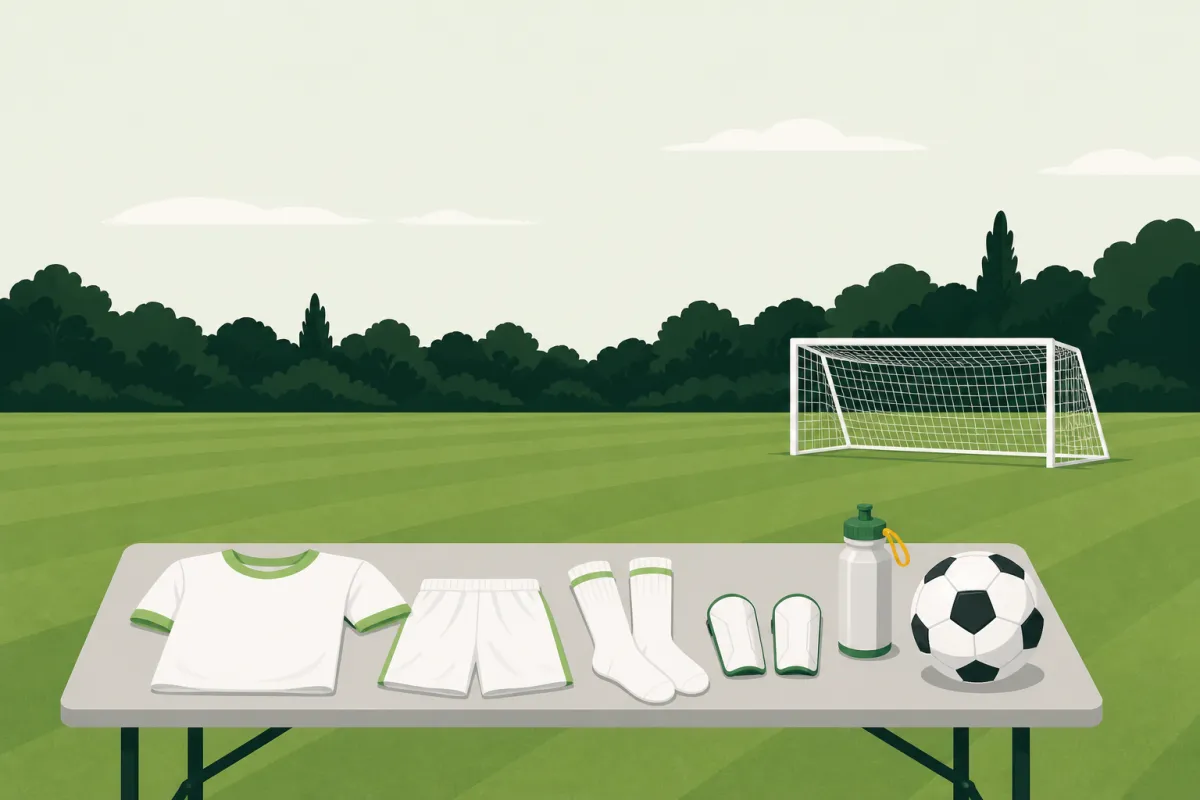
- Shin pads are compulsory in every game. They have to be covered by the socks.
- Boots. Ask the club what the training surface is before buying, because moulded studs, blades and astro trainers are not interchangeable and some venues ban certain soles.
- A water bottle with their name on it.
- Something warm and waterproof. You will spend plenty of time outside in winter.
The playing kit usually comes from the club, either included in your subscription or bought separately, and it will have a number on it. Do not buy a kit yourself before checking, because clubs need everyone matching.
Goalkeeper gloves can wait. At the youngest age groups there may not even be a goalkeeper, and where there is, children usually rotate.
The money side
Most clubs charge a subscription, either monthly or annually, and some charge a match fee on top. Ask what is included, whether it continues over the summer, and what happens if your child is injured for a long spell.
Extras that catch people out are tournament entries, cup competitions, training kit and end-of-season presentation events. Ask about likely extras at the start of the season so they do not arrive as a surprise.
If money is tight, say so early and privately. Clubs are used to this and many have a way to help, though very few advertise it.
A typical training session
One session a week is normal at younger ages, usually an hour, on a weekday evening. Some clubs add a second session as children get older.
Arrive a few minutes early, in kit, having eaten something a while before. Bring the water bottle. Then, usually, you wait at the side.
Sessions are mostly games and small activities rather than drills and laps. If it looks chaotic and everyone is touching the ball a lot, that is generally the point.
Your first match day
This is the part that surprises people most, because it takes longer than the match does.
You will usually be asked to arrive somewhere between 30 and 45 minutes before kick-off for a warm-up. Bring the registration card or ID if your club uses them, because some leagues check.
At the youngest ages the format is small, the pitch is small and the games are short, and there may be several games rather than one. Older age groups play a single fixture with halves. What your child plays depends on their age group and which UK nation you are in, and the age group rules pages set it out properly.
Take a chair if you like sitting down, and expect to be outside for longer than the football lasts. Bring more layers than you think in winter.
What is expected of you
More than you might assume, and most of it is easy.
- Tell the coach in advance if your child cannot make a match. Squads are small and a late dropout can mean the team plays short.
- Get them there on time. A warm-up matters more than it looks.
- Stay for the session or match unless the club has told you otherwise.
- Read the club's code of conduct. Most clubs and leagues have one covering behaviour on the touchline, and it is there to be used.
On the touchline, the advice from coaches is consistent and slightly counterintuitive: say less. Encouragement is welcome, running commentary and instructions are not, because a child receiving three sets of directions at once tends to stop making their own decisions.
The shape of a season
The calendar depends on where you live and which league the team plays in. Many youth leagues run their main programme through autumn, winter and spring, but start dates, breaks and summer football vary.
Your club should give you a fixture calendar or tell you when the league programme begins. Ask early about Christmas breaks, school holidays and what happens when weather causes matches to be postponed.
Winter is where enthusiasm gets tested, for parents more than children. Cancellations can happen at short notice, particularly on grass pitches, so find out how the team communicates changes before you drive somewhere.
Tournaments and festivals may sit outside the normal league programme, and are particularly common during periods when regular league fixtures are lighter. For a lot of children these are the highlight of the year.
Tournaments and festivals
Many teams enter tournaments or festivals during the season or over the summer. Depending on the event you might be there for a few hours or most of the day, with several shorter matches rather than one normal fixture.
Ask whether there is an extra charge, and what time your team is expected to arrive and finish. Bring food, water, sun cream where needed and something to sit on. There is usually a lot of waiting between games.
Our parent guide to youth football tournaments covers what a tournament day actually involves.
If it is not working out
Sometimes the club is wrong for the child, or the child decides football is not for them. Both are common and neither is a failure.
Talk to the coach first. A lot of problems are about playing time, position or a friendship group, and they are fixable once someone knows.
If you do want to move club, be aware that registration rules mean the timing is not entirely up to you, and there may be a window or a process. Ask the club and the league early rather than in the last week of the season.
Find a club near you
Search grassroots clubs by location and age group. Where age-group information is available, you can check it before contacting the club. If a listing does not yet show the detail you need, contact the club directly.
Still deciding between clubs? Our guide to choosing a grassroots football club covers what to ask first.
Common questions
How much time does this actually take?
Typically one evening a week for training and time at the weekend for matches, plus travel. Tournaments and festivals can take a few hours or most of a day. It adds up to more than the football itself.
Does my child have to go to every session?
No, but tell the coach when they cannot. Small squads mean one absence can leave a team short.
What if they are not enjoying it after a few weeks?
Give it a bit longer if you can, since the first few weeks are mostly about not knowing anybody. If it is still not right, speak to the coach before deciding.
Can they play for two clubs?
Sometimes, but the rules depend on the nation, league, age group and competitions involved. Dual registration is permitted in some circumstances and restricted in others. Tell both clubs before registering or playing elsewhere, and ask which competition rules apply. Do not assume that being allowed to train with another team means your child is eligible to play competitive matches for it.
Do I need to volunteer?
You will probably be asked, and the club will be short of people. Nothing about it is compulsory, but grassroots clubs only exist because parents do the jobs.